“I eat like a vulture. Unfortunately the resemblance doesn't end there". Groucho Marx








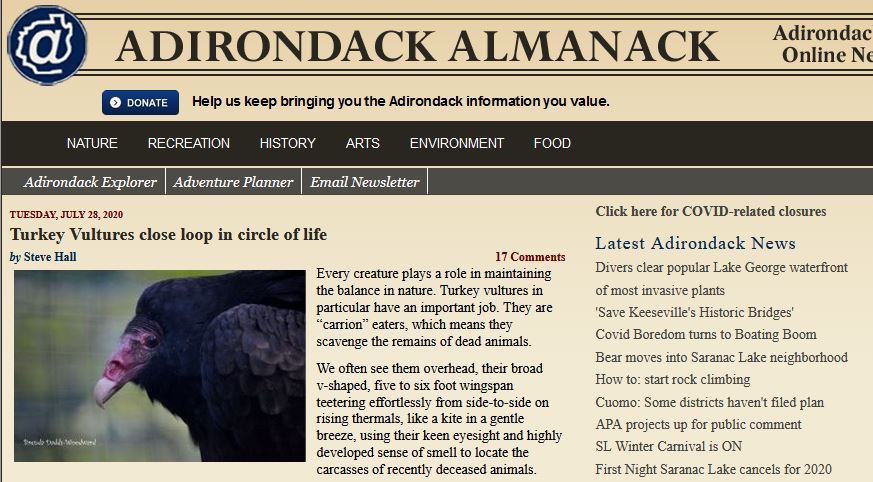
Turkey Vulture
Photo by Brenda Dadds Woodward
|
Turkey
Vultures Cathartes aura Order: Ciconiiformes
Contrary to
popular belief, circling vultures
are not always looking for a meal, but rather travel without flapping
their
wings, riding thermals up, before gliding in a gradual descent, to
where a
second thermal is detected, then repeating the process. In this manner,
turkey
vultures can fly without much flapping of the wings for up to six
hours. A
group of circling vultures, called a "kettle" (bubbles rising in
boiling water?), is as often an indication as to where rising warm
thermals are
located, as to where an animal's carcass lies. Also contrary to popular
belief,
vultures are extremely shy and wary of people, don't follow dying
animals, and
will occasionally eat shoreline insects and vegetation. I've seen one
of our
turkey vultures, Ike, eat pumpkin and squash placed in the enclosure he
shared
with Lenoire, the Raven. Large groups of
vultures, called "venues", are
often seen roosting on the bare limbs of dead trees, spreading their
wings to
dry them after rain, or absorbing heat, baking off the bacteria
picked up
during days spent with their heads in, and their bodies moving around,
carcasses. Or, we may see them circling high over an area where the
gases, most
notably ethyl mercaptan, emitting from decaying carcasses, (and used to
give
odor to odorless and potentially dangerous gases like propane),
signal
the presence of food. Slightly larger than their more
southerly cousin, the black
vulture, which, with warming climate, is beginning to show up in the
southern
Adirondacks, the turkey vulture rarely kills its own prey, preferring
to eat
road kill, fish which have washed up on shore or any
deceased creature
whose carcass has not begun to putrefy. Yes, there are actually
carcasses that
are too putrid even for vultures, and attract a whole different group
of
scavengers! Also, vultures prefer the carcasses of herbivorous animals
over
those of carnivores. One way in which raptors
differ from turkey vultures, is
that raptors have a very limited sense of smell, which is why Great
Horned
Owls, for example, eat skunks. Smells are processed by the olfactory
lobe of
the brain, which is larger than normal in turkey vultures. Old world
vultures
have no sense of smell, but, like turkey vultures, have very acute
eyesight,
which they use to locate carcasses. This is an example of
convergent evolution, wherein two creatures
who are unrelated, but evolve in environments which are distant, but
share
similar opportunities, i.e., large dead animals, end up filling
essentially the
same role, and develop similar attributes which make them come to
resemble one
another. The African vulture lives in an open area where it is easy to
spot
carrion from the air, while the turkey vulture lives in areas which
include
dense canopy, so smell becomes a key advantage. Since a vulture spends
so much
of its life with its head inside the carcass of an animal, natural
selection
has gradually removed the feathers from the head, as feathers would
accumulate
bacteria and bits of putrefying flesh. The merely asthetic tradeoff is
the vulture's
ghoulish appearance. Vultures
have no syrinx, the vocal organ found
in birds, so their vocalizations are limited to hisses and grunts. Also
in
distinction to raptors, turkey vultures have weak, almost flat feet,
which can
be used to stand on carrion, to keep it from shifting as they pick and
tear at
it with their short, ivory-colored beaks. As graceful as they appear
when
circling or gliding, the turkey vulture is quite awkward on the ground,
alternately hopping and walking, and takeoffs are clumsy and laborious.
A
surprised vulture defends itself by vomiting up a noxious stew of
undigested
material, often emptying its crop, and often making it lighter to
enable
takeoff, while its pursuer may be distracted by the free meal offered
by the
vomited material. Two eggs are laid on the ground in a protected, scratched out depression, like on a a cliff, in a cave, or in a hollow tree or abadoned barn, in April or May. Incubation lasts 38 to 41 days, and fledges leave the nest about 70 to 80 days after hatching. Vultures only have one brood per year. Vultures live about 16 years in the wild, and about 20 in captivity. Turkey vultures are protected under the International Migratory bird Treaty. Ike came to us from the Wild Center in Tupper Lake. Ike had to have a wing amputated at the wrist after being struck by a car. Turkey vultures are migrators, which is why Ike has a heat lamp in his "cave". Steve Hall |
https://www.paypal.com/biz/fund?id=7669F9TNP4U6J

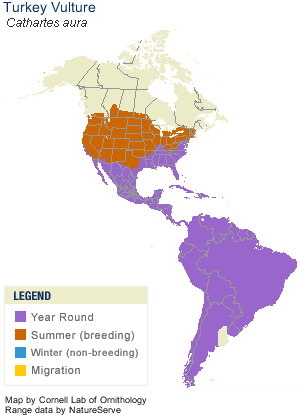
Everglades Turkey Vultures
Photo by Steve


|

| Home |
Release of
Rehabbed Animals |
Learn
About Adirondack & Ambassador Wildlife |
Critter
Cams & Favorite Videos |
History
of Cree & the Adirondack Wildlife Refuge |