
Based upon the former "Wolf Walk" at the Adirondack Wildlife Refuge

Above, Adirondack Bull Moose, West Branch of Ausable River, in Wilmington Notch,
near Whiteface Mountain, 9/22/12, by Brenda Dadds Woodward

Bull Moose in Highlands National Park, Cape Breton, Nova Scotia, Sept 2016, by Steve Hall

Bull Moose in Highlands National Park, Cape Breton, Nova Scotia, Courting Cow Moose, Sept 2016, by Steve Hall

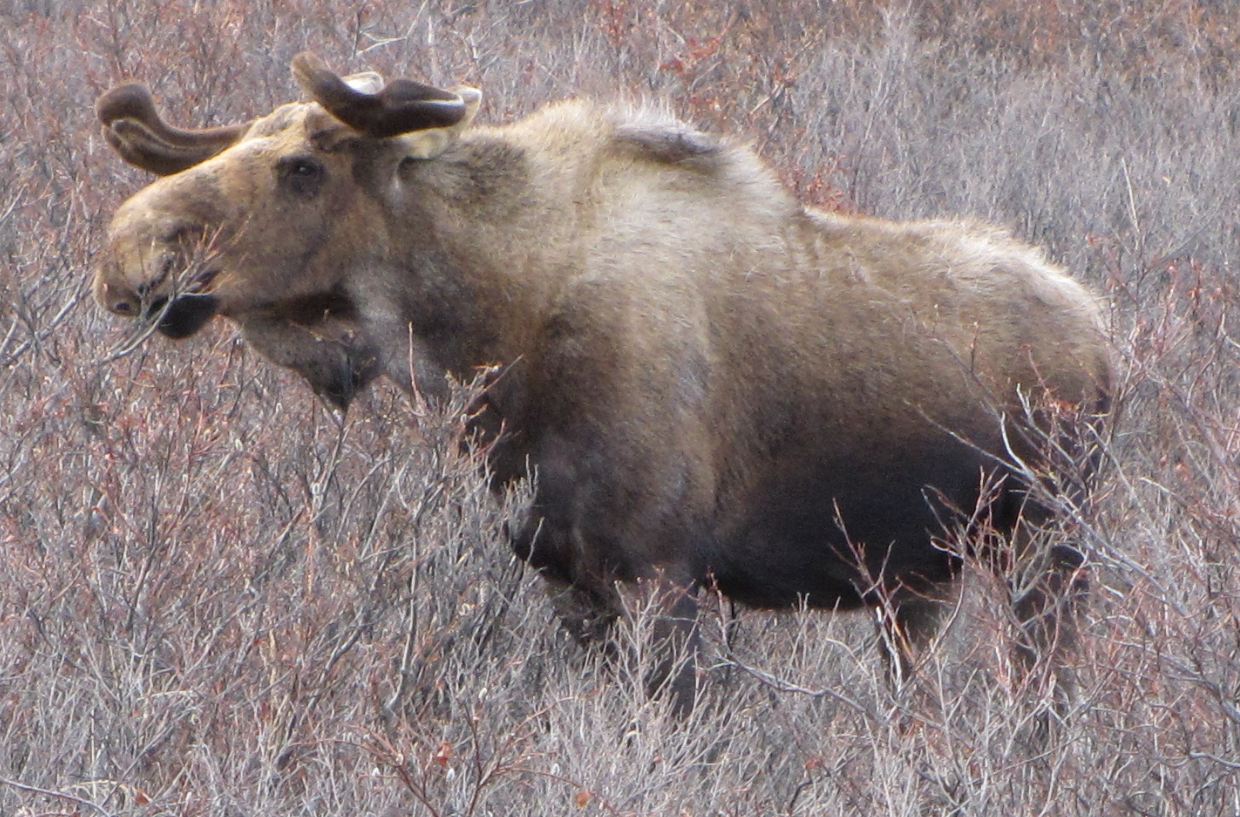
Young Bull Moose in Algonquin Park, June '98, & bull moose in Denali Nat'l Park in Alaska, May 2012, by Steve Hall

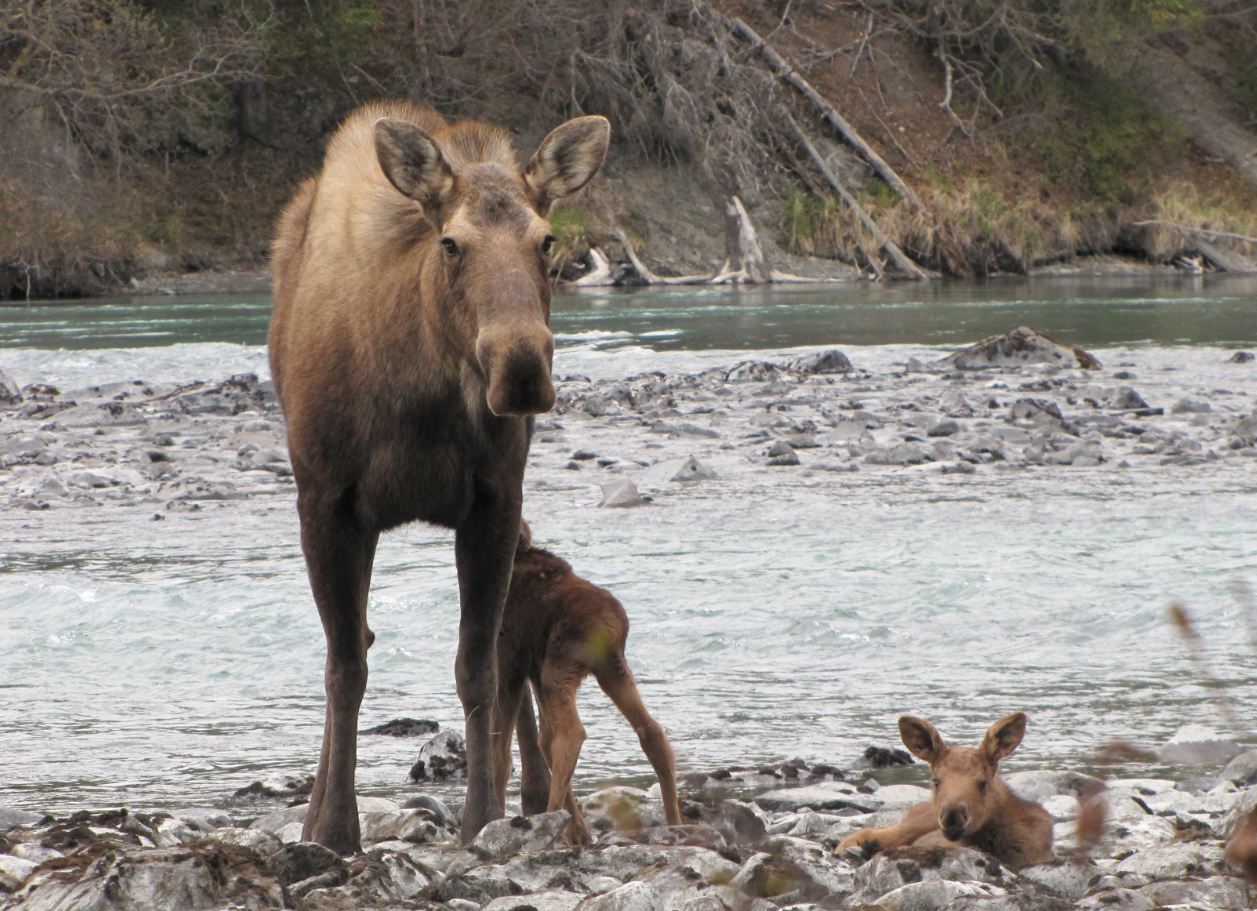
Left, Cow with calves in Homer, and right, cow with calves in Kenai, Alaska, May 2012, by Steve Hall
|
"Every creature is better alive than
dead,
men and moose and pine trees, and he who understands this, and he who understands it aright, will rather preserve its life than destroy it." Henry David Thoreau |
 Alces alces Order: Ardiodactyla Family: Cervidae Genus: Alces Moose are tragicomic characters in
Nature’s dance of life. While
wolves and bears tend to run
from humans, Moose are more likely to stand there, looking at you with
that
flat, seemingly indifferent stare, if they acknowledge your presence at
all, apparently
fearless, the thumbnail next to the entry "confidence" in the on-line
dictionary. I believe there’s more
at work here
than meets the eye. In their own strange way, moose are cool, and their
numbers
in the Adirondacks, about 800 today, are on the rise, at about a 20%
annual
rate, though climate change may reverse that trend. Moose, the largest member of the deer
family, crossed the Bering Strait land bridge into North
America about 10 to 15,000 years ago, a barely noticeable blink in the
timeline of
life on Earth, and at about the same time our CroMagnon ancestors came
across with their wolf-dog hunting companions. Evolution itself is a
blind architect, fated to perform
modification only, never having that creator’s advantage of starting
from
scratch, with a blueprint unaffected by an existing structure. Moose
speak to
the imperfections of a process in which animals evolve in one
ecosystem,
and then expand into adjoining ecosystems presenting challenges for
which they did not
evolve,
and are not prepared. Moose are enormous, herbivorous
ungulates, with large males
and females weighing in at about 1,500 and 800 lbs. respectively.
Alaskan moose are larger than new England and Eastern Canadian moose,
which are in turn larger than moose found in the western U.S. There’s
much
to recommend the vegan diet, but one shortcoming is the relative lack
of
nutrition. As a result, adult moose have to consume five tons of
vegetation per
year, ranging from cedar and balsam fir branches, and the stems of
deciduous
trees and shrubs in winter, to the leaves and stems of willow, aspen
and birch, as well as aquatic plants in
summer.
This means that moose spend about eight hours a day chewing on fresh
vegetation, and another 8 hours ruminating, rechewing food brought
up from
the fore stomach, or rumen, one of four different chambers in the
moose's
stomach. Aquatic plants fill the sodium deficiency in moose
diets,
which is why we sometimes see them road side, licking the rock salt we
use to
melt winter ice. This also means that the fates of moose
and browse targets such
as cedar and balsam fir are inexorably intertwined, such that a growing
moose population
may cause its own correction by over- browsing balsam fir, causing a
collapse
in the abundance of fir, followed by a collapse in the now starving
moose
population, whose increasing mortality rate makes the wolf’s efforts at
survival much easier and less dangerous, as they can avoid the dangers
of the hunt by scavenging dead moose, leading to an uptick in the
pack’s
numbers, and so on, as the circle of life rumbles on. Bergmann’s rule describes how
individuals within a species
are somewhat larger in colder, more northerly latitudes than in
milder
latitudes, because natural selection works on the tendency for animals
with a
larger body mass to body surface area ratio, to be more effective at
retaining heat,
and therefore more likely to mature, breed and pass along that genetic
advantage to
their offspring. As a result of tens of thousands of years of this
tendency,
moose and
wolves in Alaska are somewhat larger than their counterparts in
Montana, Minnesota and Maine. Mammal hides generally, and moose hides
in particular, are
so efficient at retaining heat, that a visitor to the Refuge, while
watching our wolves running around in playful abandon, and
wondering
what possessed him to visit the Refuge during sub-zero temperatures, quipped that the wolves didn’t seem to know how cold
it was. Even after shedding their winter coats, moose consider fifty
degrees
the optimal temperature. Being in the lake or bog gives them relief
from the
heat and biting insects, and because they can stand comfortably at
depths where
wolves would be quite literally dog paddling, relatively safe from
attack. Moose are solitary
creatures, and don’t generally herd
up the way other ungulates do. Bulls tend to live alone,
and in an
almost comical rebuke to
Intelligent Design, spend 25% of their annual energy input growing
those absurdly
massive antlers, starting in the Spring, using them during the brief
rut season
in Autumn, not only to contest mating rights with other bulls, but as
display
evidence for cows, sort of the moose equivalent of showing off a flashy
car
or
mansion, a clear indication of their strength and suitability as mates.
Many
bulls become so exhausted by the rut, they become vulnerable to wolves,
who
quickly recognize weakness, injury and vulnerability. Moose courtship is
deserving of a romantic comedy. A hairy thin layer of "velvet" covers
the antlers while they're growing, and when the antlers reach full
size, which varies with age, the bulls rake their antlers through
branches and roughage, scraping the velvet skin off the antlers, which
causes the antlers to darken in color.
By mid August,
mature bulls will begin to playfully spar with younger bulls, as a
warmup for the Autumn rut. Generally speaking, neither young or mature
bulls are injured during these sessions, which is not the case when
mature bulls spar with each other. Some bulls are killed, or so
severely weakened, they become easier prey for wolves and bears.
Courtship, whose
purpose is for mature bulls to gather and defend a harem, begins when
the bull gouges a trough out of the ground cover with their front
hooves, and then proceeds to pee in the trough, and the pee could
probably fill a gallon jug. The bull then stomps one of its front feet
into the trough, to splash the pee over their bodies, sort of a moose
cologne. During courtship, the bull may also pee on their own legs to
further accentuate the odor. An analogy would be when you see one of
those commercials where a woman sprays perfume into the air and then
steps into the resulting cloud.
It gets better.
Moose have a nose as sensitive as a bear or wolf, and when moose cows
smell the urine, they'll approach and fight each other over which of
them can roll in the urine trough. Bulls may engage in battle with
other bulls, during the period when they're mating with members of
their harem, but usually relative size sorts out which bull will
dominate. I saw the attached Nova Scotia bull, who was ultimately
scorned by the cow he was targeting, run at and drive off a smaller
bull without any fighting.
Cows are naturally very protective of
their calves, and will drive away predators and other moose, the latter
in response to protecting food sources.
Ask any wolf who’s had his skull caved in by Mama Moose’s sharp and
heavy
hooves, when they got too aggressive with her calf. Like all ungulate
calves, moose need protection as
they’re
only about 30 lbs. when born in May, bulking up to about 300 lbs.
within six
months to be prepared for the hardships of winter. Ungulates tend to struggle more through
a winter of deep
snows, as their relatively heavy torsos and sharp hooves force them to
pole
through snow, while wolves not only have snowshoe-like paws, which
enable them
to distribute their weight effectively, allowing them to run on top of
compacted snow, but share the burden of breaking through lighter,
deeper snow by
following in each other’s wakes, and taking turns leading the pack. White tail deer have been in North
America for 4 million
years, and carry meningeal or "brain worm", giant liver fluke and the
winter tick, parasites
which deer
are able to manage and live with. Moose sharing habitat with deer, pick
up
these parasites, and being relative newcomers to our neck of the woods,
fare
less well. Brainworm and liver flukes
are passed to moose through a cycle involving deer droppings, snail
infection and
the ingestion of leaves contaminated by deer pellets or snails.
Brainworm, which produce larvae on the surface of the white tail brain,
work
through the moose brain tissue, destroying the brain, and causing
weakness,
reduction of equilibrium, disorientation and often death in moose.
Flukes are
rarely fatal, but can work with other health issues to weaken moose and
make
them more vulnerable to wolves and other natural fates. A white tail deer will pass through
winter with up to 300
ticks, and have the ability to detect and remove most of the newly
hatched seed ticks
through
licking and rubbing when the ticks climb aboard in autumn, often in
clumps,
from
vegetation brushed by the deer. The ticks are aided in
this boarding
strategy by their ability to detect the carbon dioxide exhalation of
approaching
mammals, and the fact that excited ticks can quiver, cluster, shake and
flip onto the unfortunate moose, sort of like dog fleas at their own
disco. For some reason, moose either do not feel the ticks, until they
have
climbed
up the torso and the female ticks begin biting and drawing blood, or
they are less able to detect their presence. Ed Reed, a biologist with
the New York Department of Environmental Conservation, pointed out
during a presentation on moose, that moose are not as effective at
grooming as are white tailed deer, and their massive head and stubby
neck
make it difficult to stretch around and reach their hind quarters with
their tongues. In addition, Ed pointed out that the Winter tick passes
through three developmental stages while on the moose, each of which
involves taking blood from the moose. By January, an adult moose may be
carrying
anywhere from 10,000
to 80,000 ticks, and while an individual tick takes an insignificant
amount of
blood, moose can reach a tipping point where the ticks are removing a
significant amount of the blood generated naturally by bone marrow and
haematopoietic cells,
leading to loss of energy. In addition, the itching caused by ticks and
mites
lead the moose to bite at their itchy coats, and vigorously rub their
bodies incessantly
against rough-barked trees, leading to coat loss and possibly
hypothermia. These
factors, when
combined with the lower nutrition intake of moose in winter, which,
following
Bergmann’s rule, exposes the moose to possible starvation, threaten the
moose’s
life, making the stretch between mid-March and mid-May the most
vulnerable period
in an adult moose’s year. Moose tend to be safe from wolf attack
between the ages of
sexual maturity, at about three or four, until they are eleven or
twelve. The
reason is that an adult moose is such a powerful and dangerous
adversary, that naturally
cautious wolves approach about 20 moose for each one they decide to
attack.
Bulls live about twelve to twenty years, while cows may last a few
years longer. Moose spend so much time eating that
they’re not great
wanderers, and may not move more than about forty miles from the area
of their
birth, a distance your average wolf pack may travel in a single day,
during the
course of exploring their territories for moose and other prey. Because
wolves
tend to defend huge territories, averaging about 200 to 400 square
miles, an
individual moose could spend its entire life within a given pack’s
territory. Wolves
concentrate their territory defense by spending more time patrolling
their
territory’s periphery, and may pass through any point on that periphery
every two weeks or so. Just as our visual acuity, and more
precisely our ability to
resolve color, is probably our most important sense when it comes to
memory, it’s
not too much to claim that while sharp eyesight and keen hearing are
indispensable
to wolves, to a large extent the world comes to wolves and other canids
principally through their noses. After bears, wolves have the most
efficient and
sensitive noses in the mammal kingdom, and use that powerful
information
gathering tool, to read the olfactory record of the comings and goings
of prey
and poaching competitors like bears, coyotes, bobcats and other
wolves. Talk about "unnatural selection", all dogs were forcibly bred
out of wolves, the first "hunting
dogs", between fifteen and thirty thousand years ago, according to
archaeology, or about 130,00 years ago, according to DNA studies, which
helps
explain why your dog behaves so territorially, constantly sniffing and
scent marking. Wolves may build
olfactory
memories
of individual prey animals, and may approach the same moose many times
over the
course of its life, probing and testing to see if the moose has become
more or
less vulnerable than it was before. But, alas, moose have much bigger
problems
in nature than living
among wolves. Half of all moose develop arthritis by age ten, due to a
combination of genetic predisposition and maternal malnutrition during
pregnancy, and the fact that moose spend so much time standing and
eating,
supporting those large torsos on their legs. Cartilage in the knee and
hip
joints breaks down, leaving the moose in pain, hobbled by swollen
joints, and,
again, vulnerable to attack by the ever testing and investigating
wolves. Jaw necrosis is another common fate for
moose. Moose haven’t
learned how to floss yet, so the constant overuse of the jaw, and the
fact that
moose are often reduced to chewing on leafless, deciduous stems and
shoots in
winter,
results in the jamming of woody material between the teeth. The moose
will
use its
rough tongue in attempts to dislodge the material, but if it begins to
break
down and rot, the jaw may become infected and weakened, leading to jaw
fracture
during mastication, dooming the moose to slow starvation. Starvation is the number one killer of all
wildlife, moose included, and sometimes the intervention by wolves may
interrupt
a slow and horrible process. Like other large North American mammals,
moose are subjected to enormous pressure from vehicular accidents, as
well as by hunting, whether subsistence or trophy, and their wide and
successful dispersal over much of North America today, is due largely
to the wildlife management processes enforced by state and provincial
governments, and to the North American conservation ethic generally. In short, moose in North America are still strangers in a strange land, and have to overcome significant hardships to survive. No wonder they always look like they have a chip on their shoulders. Steve
Hall
|

Newborn moose calf, Homer, Alaska, May 2012, by Steve Hall

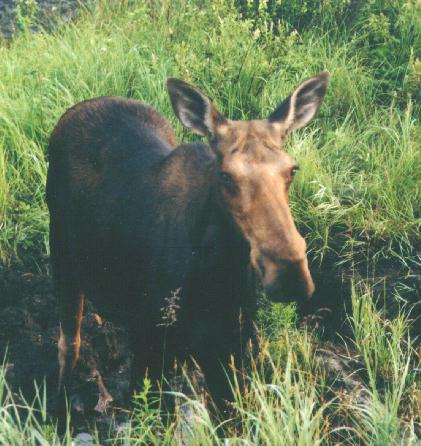
Above, Cow Moose in Algonquin Park '98, & below, with calf, by Steve

Great link for more information on moose and wolves:
http://www.isleroyalewolf.org/wolfhome/home.html

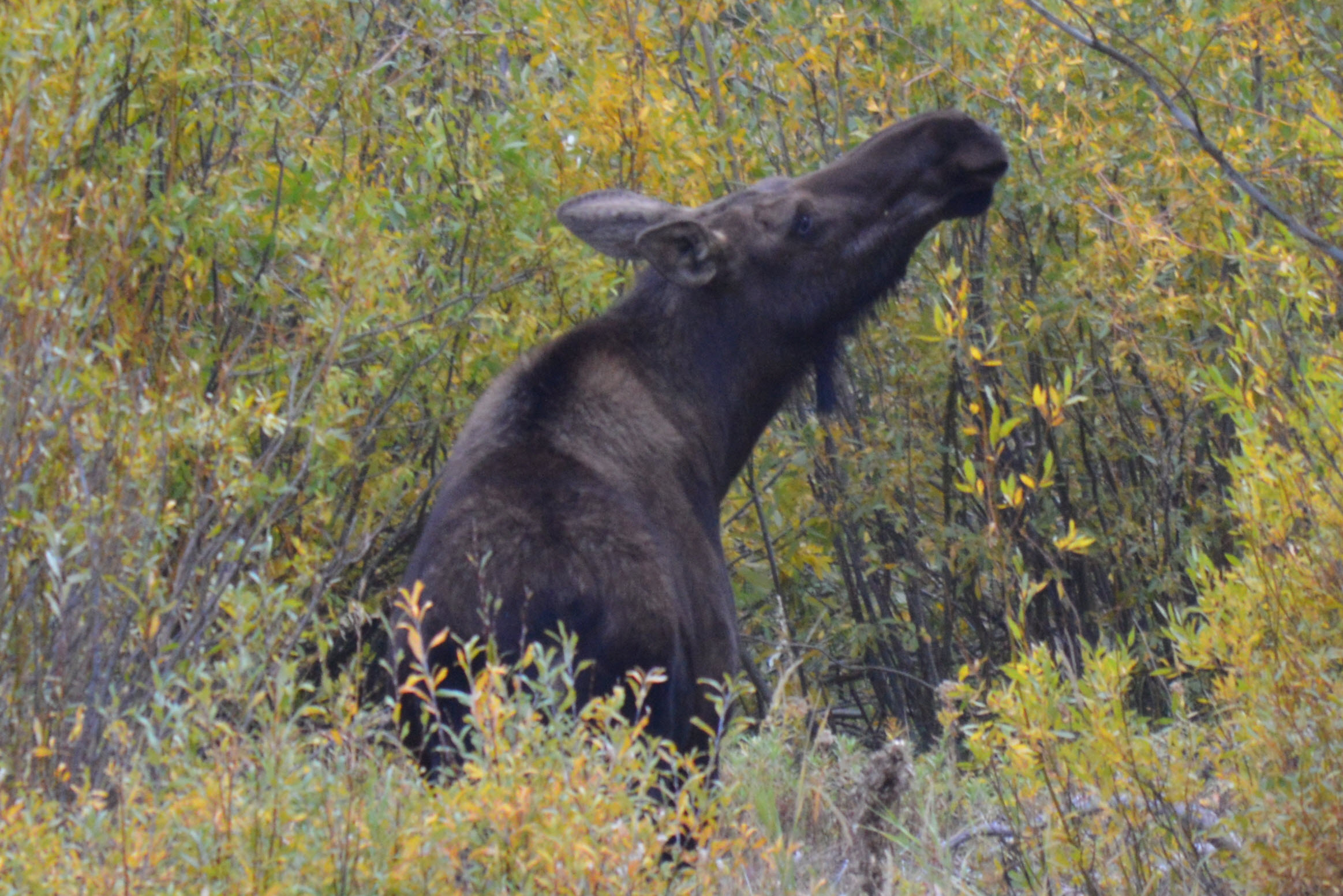
Above, Cow Moose outside east Gate of Yellowstone, near Waipiti, Wyoming, Sept. 2012, by Steve
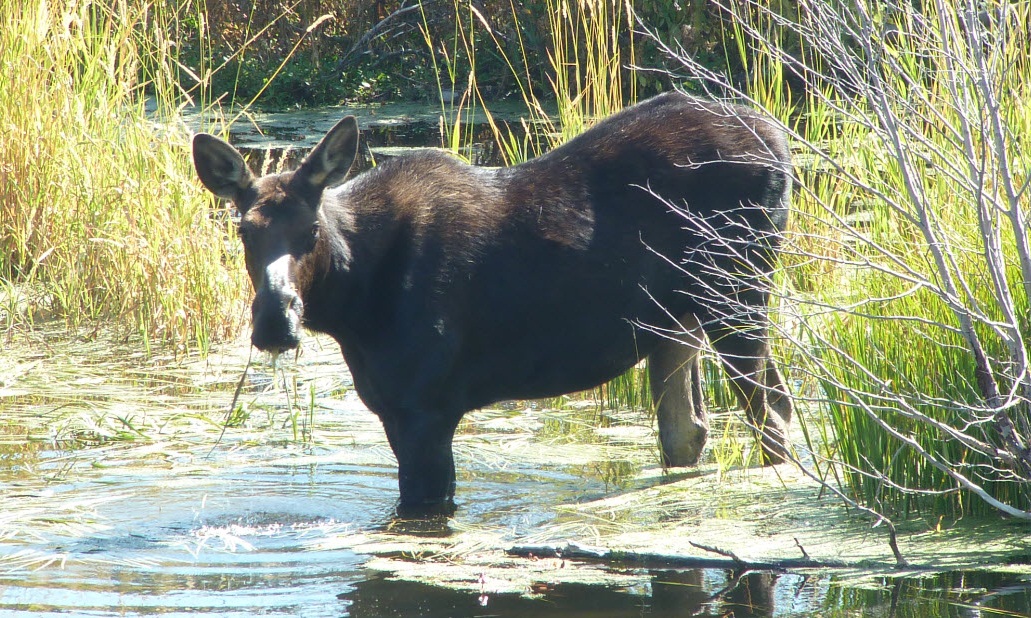

Above, Cow Moose in Rockefeller Preserve, Grand Tetons Nat'l Park, Sept. 2012, by Steve & Bharath
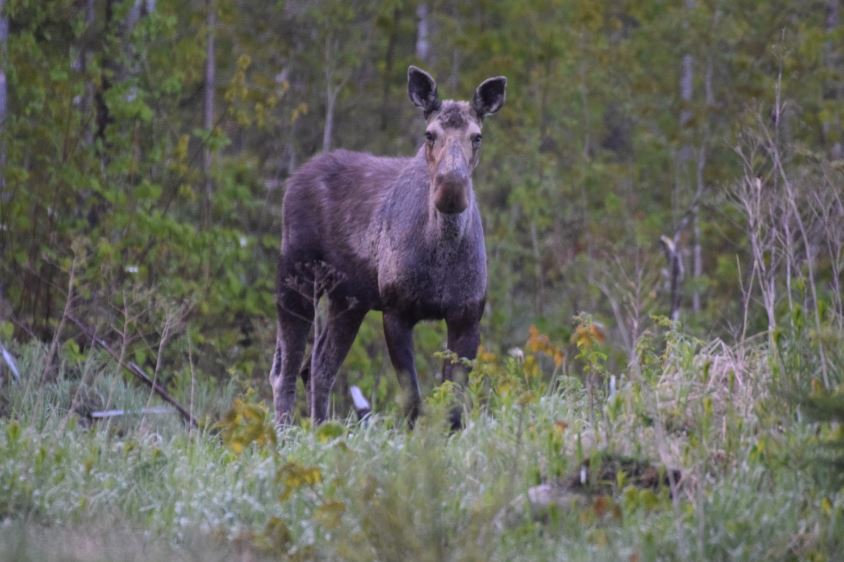
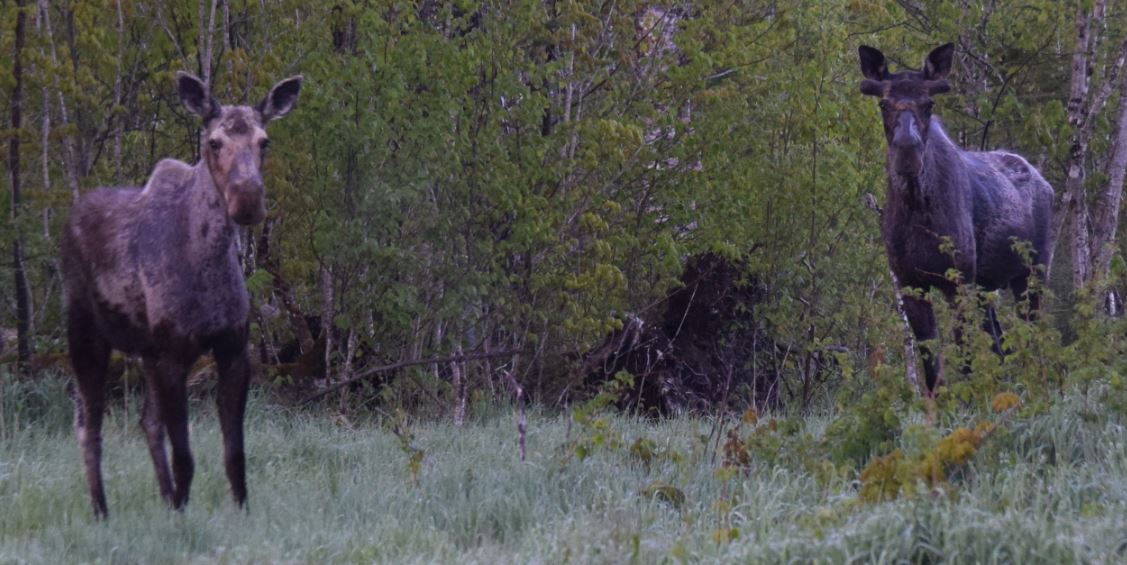
Above, Cow Moose and possible sib Bull, Moose Alley Logging Rd, along NH-Maine border, just under Canadian border, May 2022


Moose Cow, Moose Alley Logging Rd, Pittsburg, NH, along NH-Maine border, just under Canadian border, Sept 2022


Bull Moose, Moose Alley Logging Rd, Pittsburg, NH, along NH-Maine border, just under Canadian border, Oct 2022
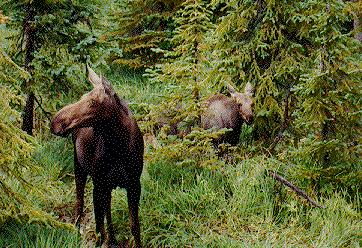
Cow and calf, Lolo Pass, Montana-Idaho border, August 1990, by Steve or Dan Hall


What are we reading? Click on image to go to Amazon link


| Home |
Wolf |
Eastern Coyote |
Red Fox |
Arctic Fox |
Bobcat | Moose |
Opossum | Osprey | Bald Eagle |



|
Artists Home |
ADK Vacation Rentals |
ADK Real Estate |
|||||||||||
Photographs from Adirondack Habitat Awareness Day










Contact
Information
Adirondack Wildlife
Steve & Wendy
Hall
PO
Box 360, 977 Springfield Road, Wilmington, NY 12997
Toll Free:
855-Wolf-Man (855-965-3626)
Cell Phone:
914-715-7620
Office Phone 2:
518-946-2428
Fax: 518-536-9015
Email us: info@AdirondackWildlife.org